Factorio: distinguish steam capacity from current engine demand
A steam engine can show low production because the factory currently needs little electricity. That is different from a fuel or steam shortage. Build a small one-boiler, two-engine reference and use the machine information to separate possible output from output being requested now.
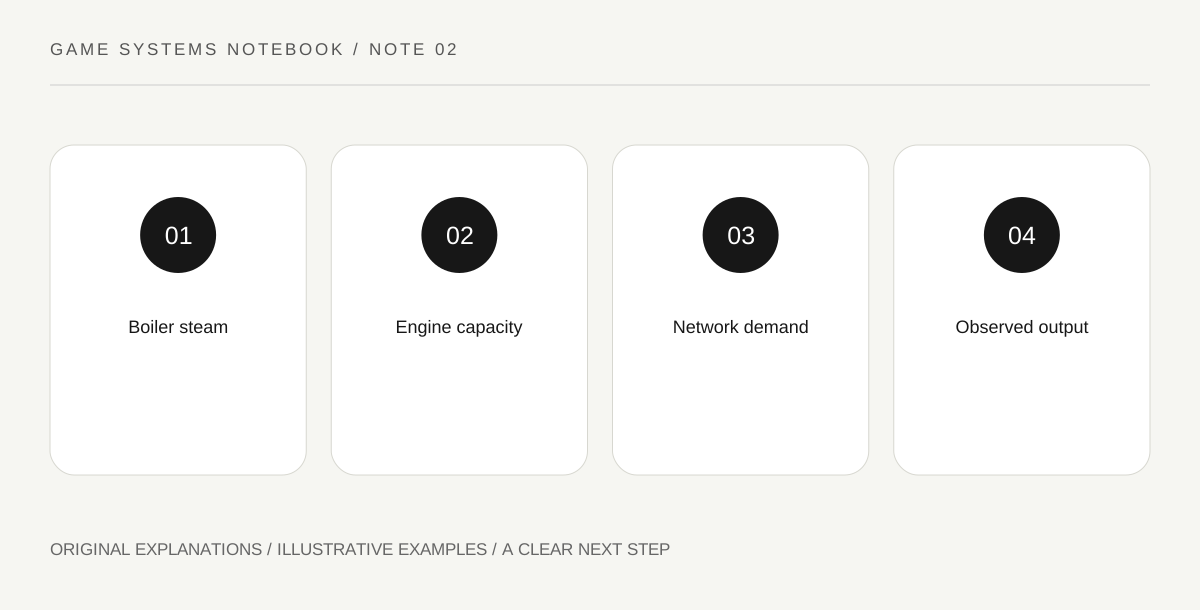
Original explanatory diagram. Read the full method and limitations below.
Establish the normal-quality reference
For the ordinary base-game equipment in this exercise, one boiler can produce sixty steam per second and one steam engine can consume thirty per second at its normal maximum. This supports a two-engine reference for one boiler. Each normal-quality engine can supply up to nine hundred kilowatts. These values describe equipment capacity, not a guarantee that every connected setup will continuously produce that amount regardless of fuel, connections or demand.
Trace water and steam through different ports
The boiler’s water connections and steam output serve different roles. Inspect the placement indicators and connect the engine to the steam side rather than assuming any adjacent pipe carries the right fluid. The boiler also needs fuel. A missing water connection, wrong port or empty fuel slot can interrupt the chain before the engine’s own electrical connection matters. Keep the first build compact enough that every link remains visible.
Read the electrical demand context
Steam engines adjust production and steam consumption according to their network’s demand. A lightly loaded practice grid may therefore use only part of the available capacity. Inspect the network information and the engine’s available versus current performance. Do not add more boilers solely because the engine animation looks slow. First ask whether the existing consumers are requesting more power than the current system supplies.
Change one load in a controlled observation
Add or enable a small familiar consumer in the practice area, then inspect the engine and network again. The purpose is to see a change in demand, not to create an artificial benchmark or claim a measured result in advance. If the system cannot respond, inspect fuel, water, steam and network connection. Record the state you observed, keeping capacity, demand and actual production in separate notebook fields so one number does not stand in for all three.
Illustrative worked example
Illustrative calculation: Two ordinary engines have a combined possible output of 1.8 megawatts. If a fictional practice grid requests only 0.3 megawatts, low current output is consistent with spare capacity rather than proof of failure. The player should inspect their own network and fluid states before drawing that conclusion in a real save. The arithmetic is a learning example, not a performance report from a tested factory.
Questions that come up
Will hotter steam always produce more engine power?
No. A steam engine has its own temperature and consumption limits. Use the appropriate equipment and reference rather than assuming that a hotter fluid overrides the machine’s limits.
Does the two-engine reference solve every power problem?
No. It explains one capacity relationship. Fuel supply, fluid connections, power poles and the factory’s changing demand still need to work together.
References and scope
These sources support the factual background. Examples and exercises are original illustrative teaching material. References do not imply endorsement.
- Official Factorio Wiki: Boiler — Water and steam ports and normal-quality steam output.
- Official Factorio Wiki: Steam engine — Steam use, normal-quality output and demand-following behavior.
- Official Factorio Wiki: Electric system — Electric networks, pole connections and supply coverage.