Factorio: separate roboport coverage from robot charging demand
A roboport provides network areas and charging access, but those functions answer different questions. A build can lie in coverage while robots queue to charge. Inspect the area overlays and the robots' current behavior before assuming that another distant roboport automatically solves the problem.
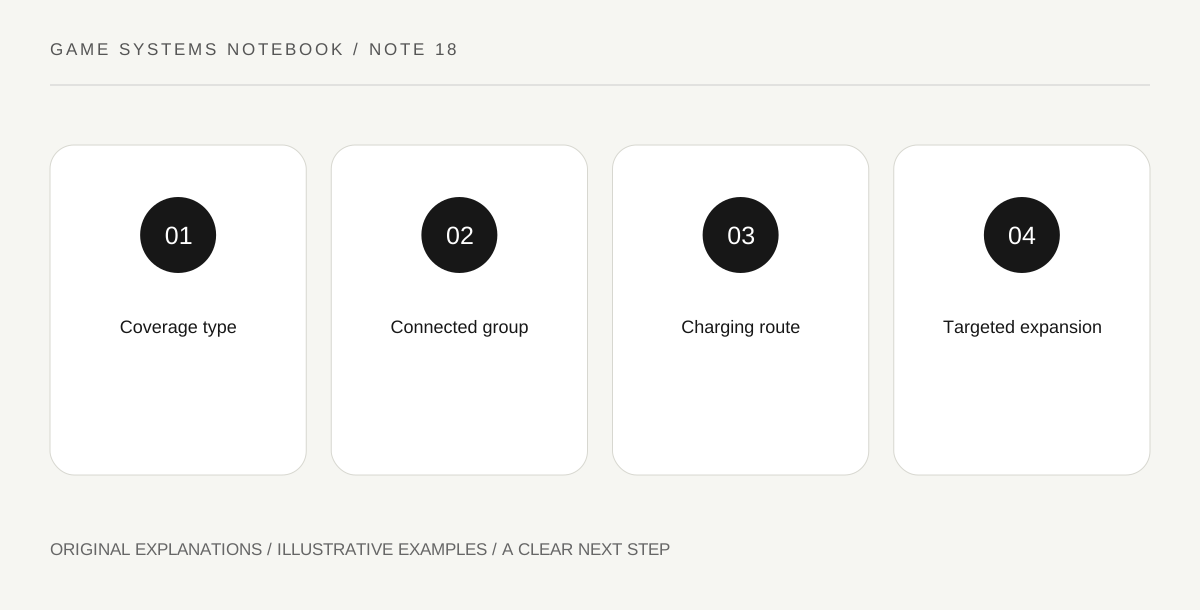
Original explanatory diagram. Read the full method and limitations below.
Read the two coverage areas
Inspect the roboport’s logistics and construction areas in the placement overlay. They support different tasks and should not be treated as one interchangeable circle. A chest intended for logistics needs the relevant logistics coverage; a construction task uses construction coverage. Begin with one port and one task so the relationship is visible. The outer reach of one function does not automatically grant the other function at the same location.
Verify the intended network connection
Nearby roboports must form the appropriate connected logistics network for shared logistic tasks. Merely overlapping a larger construction area is not enough to establish every logistics connection. Use the game’s connection visualization to confirm which ports belong together. A map that looks visually covered can still contain separate networks. Record the relevant group rather than assuming all robots and chests on the screen can exchange work across any gap.
Observe charging as a local service
Robots consume energy and use roboports to recharge. A visible queue near a busy port points toward charging demand at that location, which differs from a task being out of range. Inspect where robots travel and where they wait. Do not count all roboports on the map as equally useful to this local flow. A distant port may add another network area while doing little for the heavily used travel path you are observing.
Choose expansion according to the observed task
If coverage is missing, extend the relevant connected area. If the main issue is a charging queue, consider the placement and capacity serving that route, along with electrical supply. If items are absent, more ports do not create stock. Keep coverage, connectivity, power and task inputs in separate notes. The diagnosis should identify what the next port is meant to improve, rather than treating more robot infrastructure as a universal response to any stalled delivery.
Illustrative worked example
Illustrative observation plan: A practice network covers a construction site, and robots reach it, but many return to one busy port to charge. The player marks that travel path separately from the coverage outline. They then consider an appropriate local infrastructure change and inspect the result in their own save. The example does not promise a particular throughput improvement or claim that every queue requires another port.
Questions that come up
Does construction coverage mean a chest is in logistics range?
Not necessarily. The overlays represent different functions. Inspect the logistics area for logistics participation.
Will more robots solve a charging queue?
Not automatically. Additional robots can add demand without improving charging access. Identify the limiting condition before increasing the fleet.
References and scope
These sources support the factual background. Examples and exercises are original illustrative teaching material. References do not imply endorsement.
- Official Factorio Wiki: Roboport — Separate coverage areas, network links and charging.
- Official Factorio Wiki: Logistic network — Provider, storage and requester roles.