Factorio: choose passive provider or storage by the chest’s job
Robot logistics uses chest roles rather than treating every container as interchangeable. Compare a chest that offers newly produced items with one that can receive general storage deliveries. This guide focuses on passive provider and storage roles inside one connected logistics network.
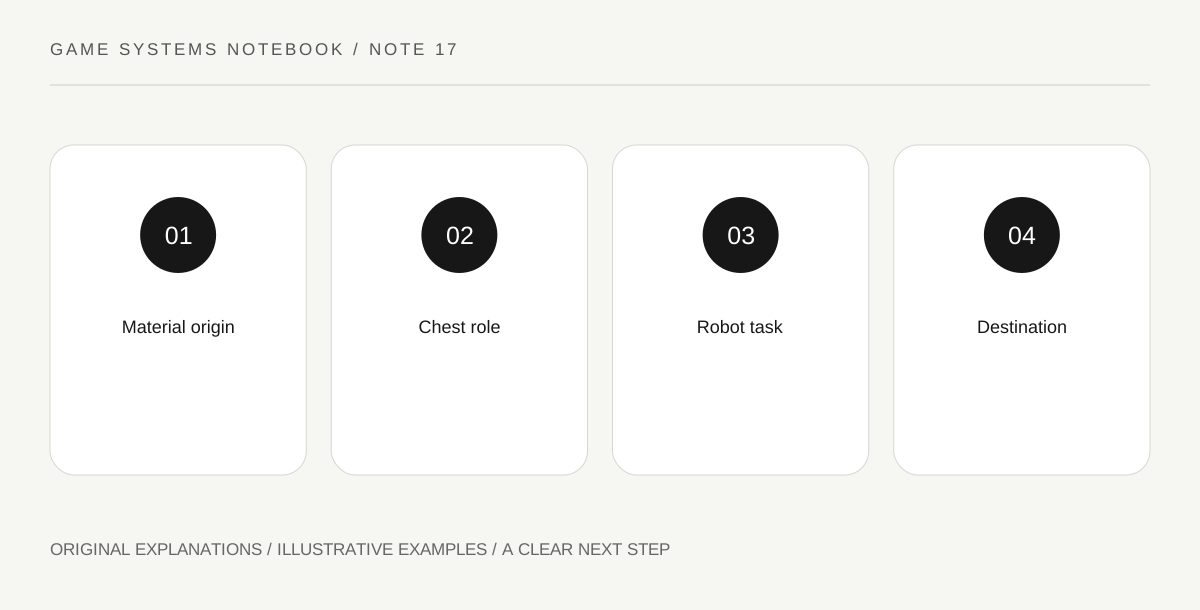
Original explanatory diagram. Read the full method and limitations below.
Name the material flow first
Ask where the items originate and where they need to go. A machine output offered to the robot network is a different job from receiving items removed by construction robots. Write the flow as source, robot task and destination before selecting a colored chest. Color is a useful recognition cue, but the role explains the behavior. A player who remembers only red chest or yellow chest may choose a familiar appearance without matching the intended task.
Use a passive provider to offer stock
A passive provider chest makes its contents available for appropriate logistics requests without actively demanding that everything be removed immediately. It can therefore suit a small machine-output supply in the practice area. It is not a requester that pulls missing ingredients into itself. Put a modest known item stock inside and inspect whether the network can see it, keeping the distinction between offered inventory and requested inventory clear.
Give returned material a storage destination
Storage chests can receive items carried for storage, including suitable deconstruction returns within the network. They serve a different role from merely offering a machine’s output. A storage destination also needs usable capacity and appropriate settings. Do not assume that a passive provider chest with empty slots substitutes for every receiving role. The receiving job is part of the logistics rules, not just a question of whether a box has physical room.
Inspect network membership and task demand
A correctly chosen chest outside the relevant logistics coverage may not participate as expected. Likewise, offered stock without any request may remain in place. Inspect coverage, connected roboports, available robots and the actual task before replacing chests at random. Record the chest’s intended role and the observed request or return flow. This turns a color-coded system into a readable material route that remains understandable when the factory grows.
Illustrative worked example
Illustrative layout: A small assembler places belts into a passive provider chest for later requests. A separate storage chest has room for items returned from a nearby deconstruction task. The player labels one chest offered machine output and the other returned material storage. They then inspect both within the same network. No delivery rate is assumed; the exercise is to choose roles that match two different flows.
Questions that come up
Will robots empty a passive provider immediately?
Not merely because it exists. Its contents are available for suitable requests; that is different from an active instruction to remove everything.
Can empty space replace the correct chest role?
No. Physical capacity and logistics behavior are separate conditions. Choose a receiving chest role appropriate to the task, then check capacity and settings.
References and scope
These sources support the factual background. Examples and exercises are original illustrative teaching material. References do not imply endorsement.
- Official Factorio Wiki: Logistic network — Provider, storage and requester roles.