Factorio: select the recipe before planning an assembler’s fluid port
A fluid-using recipe adds a connection requirement that a solid-item assembler layout may not satisfy. Select the intended recipe, inspect the machine’s fluid connection and route the correct fluid there. Begin with one assembling machine so the geometry remains easy to understand.
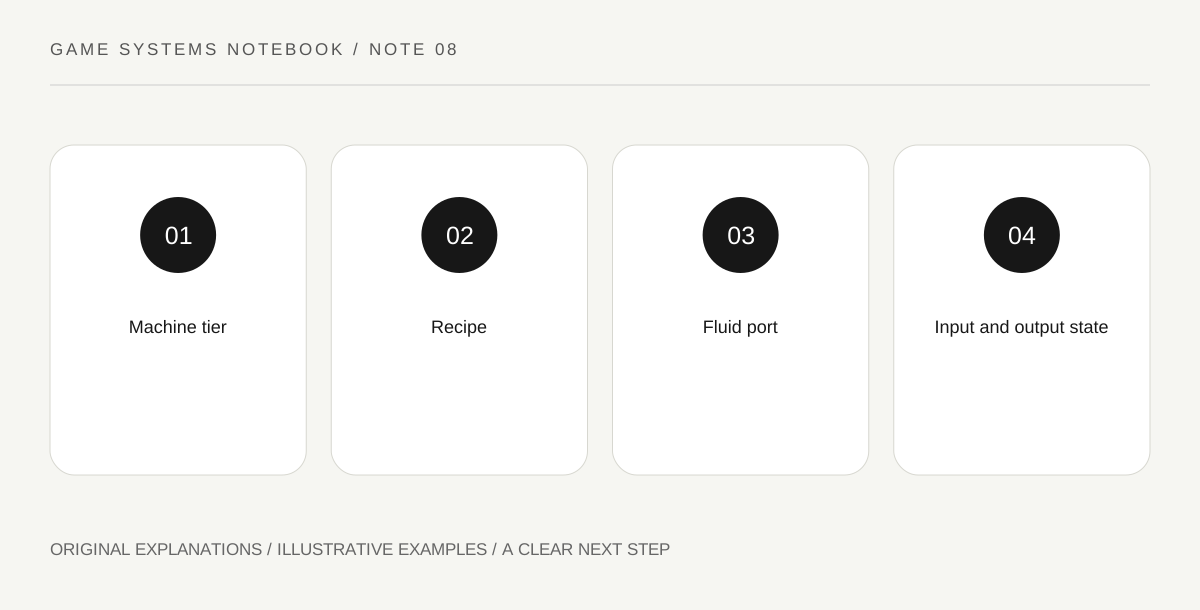
Original explanatory diagram. Read the full method and limitations below.
Confirm the machine supports the recipe
Use an assembling machine appropriate to the recipe in your installed base game. This exercise focuses on assembling machine 2 and its fluid-capable recipes. An earlier machine that cannot perform the desired recipe should not be diagnosed as though it merely lacks a pipe. Open the recipe selection and confirm that the target is available before designing the surrounding belts, inserters and fluid route.
Inspect the port after recipe selection
Choose the recipe and look at the machine’s connection indicator. The relevant fluid port depends on the machine and recipe arrangement, so place or rotate with the actual preview in view. A pipe adjacent to the machine is not necessarily connected to the required port. Keep enough space around the practice assembler to inspect that relationship rather than hide the connection behind several belts and inserters immediately. Keep the connected side visible in your build note.
Compare every required input with the inventory
The recipe may need both solid items and a fluid. Open the assembler and compare the required ingredients with what is present. A full solid-input inventory cannot replace an absent fluid. Likewise, a connected fluid line does not prove that the line carries the required fluid or that the machine has the other ingredients. Keep each input as a separate check so a visually busy setup does not conceal one missing condition.
Observe the output path as another condition
Once inputs and power are available, the output still needs somewhere to go. Inspect whether the assembler is blocked by its product inventory before adding more input machines. If you change the recipe later, recheck the fluid connection and remaining ingredients rather than assuming the old arrangement remains valid. A useful build note includes machine tier, selected recipe, fluid identity and port orientation, which are more informative than a screenshot labeled assembler setup.
Illustrative worked example
Illustrative build plan: A player chooses a base-game recipe that uses fluid and solid ingredients in assembling machine 2. They select it first, identify the port in the preview and route the correct pipe to that side. The notebook lists the fluid separately from the solid ingredients. After observing their own machine, they record whether the limiting condition was fluid supply, a solid input, power or a blocked output.
Questions that come up
Will any nearby pipe feed the assembler?
No. The pipe must connect to the relevant fluid port and carry the required fluid. Proximity alone does not establish that relationship.
Should I copy the same layout for every recipe?
Only after checking the new recipe’s requirements. A reused machine layout can preserve an inappropriate fluid connection or input arrangement.
References and scope
These sources support the factual background. Examples and exercises are original illustrative teaching material. References do not imply endorsement.
- Official Factorio Wiki: Assembling machine 2 — Recipes with fluids and assembler fluid connections.